
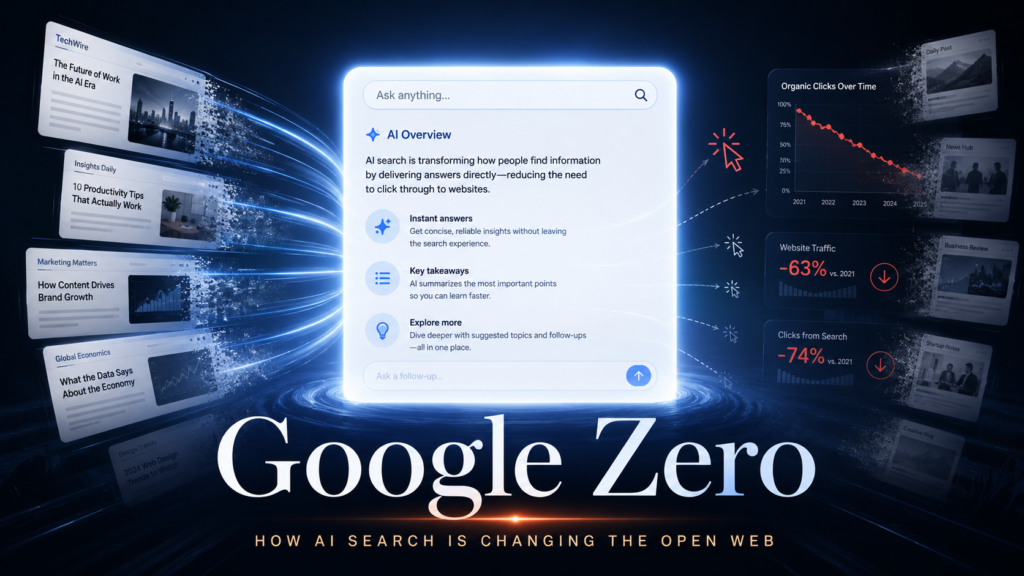
For more than two decades, Google was the main gateway to the internet.
People searched. Google displayed results. Users clicked on websites. Businesses, publishers, bloggers, and content creators received traffic in return.
This simple exchange shaped the modern digital economy.
Companies invested in websites because they could be discovered. Publishers created articles because search traffic brought readers. Experts shared knowledge because Google helped people find it. SEO became one of the most important digital marketing channels because ranking on Google could directly lead to visibility, leads, sales, and growth.
But that model is changing.
Google is no longer only a search engine that sends users to websites. It is becoming an answer engine that increasingly provides information directly on the search results page.
With AI Overviews, zero-click searches, featured snippets, knowledge panels, Maps, YouTube results, and other Google-owned experiences, users often get the answer without visiting the original website.
This shift is creating a new challenge for businesses and publishers: Google Zero.
Google Zero describes a future where websites may still be indexed, may still appear in search, and may even be used as sources — but receive far fewer clicks from Google.
For companies that depend on organic search traffic, this is not a small technical change. It is a major strategic shift.
From Search Engine to Answer Engine
The original role of Google was simple: organize the web and help people find the most relevant pages.
If someone searched for “best CRM system for insurance companies,” Google would show a list of websites, articles, software providers, reviews, and guides. The user would click, compare, read, and make a decision.
Today, Google increasingly tries to answer the question immediately.
Instead of sending users to a website, Google may generate a direct AI summary at the top of the page. This AI-generated response can combine information from multiple sources and present it in a short, convenient format.
From the user’s perspective, this is fast and useful.
From the website owner’s perspective, it is more complicated.
The website may have created the original content, but Google keeps the user on its own page.
The result is a major change in the value exchange between search engines and content creators.
Websites provide the knowledge. Google provides the answer. But the website may not receive the visit.
What Is Google Zero?
Google Zero is the point where traffic from Google drops dramatically or almost disappears.
This can happen when users no longer need to click because the answer is already displayed in search results.
For example, someone may search:
“How to improve website speed?”
In the past, the user would likely click an article from a digital agency, developer blog, or SEO expert.
Today, Google may show an AI-generated answer with a list of recommendations:
Compress images.
Use caching.
Reduce JavaScript.
Improve hosting.
Use a CDN.
Optimize Core Web Vitals.
The answer may be correct. It may even be based on content from websites that invested time and expertise into writing detailed guides.
But if the user does not click, the original website receives no traffic.
This is the core issue behind Google Zero.
The search engine still depends on content created by others, but it no longer distributes traffic in the same way.
The Rise of Zero-Click Searches
A zero-click search happens when a user searches for something but does not click on any external website.
Some zero-click searches are understandable. If someone searches for the weather, a currency conversion, a time zone, or a simple definition, they often want an instant answer.
But the problem becomes more serious when zero-click behavior expands into commercial, educational, technical, and expert-driven topics.
Examples include:
“Best digital marketing strategy for small businesses”
“How AI automation improves sales”
“Best CRM for insurance companies”
“How to choose a hosting provider”
“What is the best SEO strategy in 2026?”
“How to secure a WordPress website”
“How much does custom software development cost?”
These are not simple questions. They often require context, experience, research, and professional judgment.
If AI search answers these questions directly, businesses may lose one of their most important sources of qualified website traffic.
Why This Matters for Businesses
For many companies, organic search has been one of the most valuable digital channels.
A well-optimized website can attract people who are actively looking for a solution. These users often have high intent. They are not randomly browsing. They are searching because they need something.
That is why SEO has always been powerful.
A user searching for “digital marketing agency in Skopje” or “custom software development company” is already closer to making a business decision than someone passively seeing an ad.
But if search engines increasingly answer questions without sending users to websites, companies need to rethink their digital strategy.
The goal can no longer be only to rank on Google.
The goal must be to build a stronger digital presence that includes search visibility, brand authority, direct traffic, content quality, technical performance, conversion optimization, and multi-channel communication.
In other words, businesses need to move from traditional SEO to a broader digital visibility strategy.
AI Overviews and the New Search Experience
AI Overviews are one of the clearest examples of how search is changing.
When a user asks a question, Google may display an AI-generated response above the normal organic results. This response often summarizes information from multiple websites.
This creates a new search experience.
Instead of exploring different sources, the user receives one combined answer.
This can reduce the need to click through to individual websites.
For users, this is convenient.
For businesses, it creates three challenges.
First, visibility no longer guarantees traffic. Your website may appear as a source, but users may not visit it.
Second, traditional rankings may become less valuable for informational searches. Even if your page ranks well, an AI Overview may satisfy the user before they reach your result.
Third, content needs to be more distinctive. Generic articles that repeat common information are easier for AI to summarize and replace.
This means companies must create content that is harder to reduce to a short answer.
Generic Content Is Becoming Less Valuable
For years, many websites followed a basic SEO formula:
Find a keyword.
Write a long article.
Use headings.
Add keywords.
Answer common questions.
Publish regularly.
This approach worked when Google mostly ranked pages and sent users to them.
But in an AI-driven search environment, generic informational content is at higher risk.
If an article simply explains the same basic information found on hundreds of other websites, AI can summarize it easily.
For example, an article titled “What Is SEO?” may still be useful, but it is not highly unique. AI tools can answer that question instantly.
A stronger article would be more specific, experience-based, and practical, such as:
“How a Local Business in Macedonia Can Use SEO to Generate Qualified Leads”
“Why Technical SEO Still Matters for WordPress Websites in 2026”
“How AI Search Changes Content Strategy for B2B Companies”
“What We Learned from Optimizing Website Performance for Real Clients”
The difference is originality.
AI can summarize general knowledge. It is much harder to replace real experience, original analysis, client examples, industry-specific insight, and practical implementation knowledge.
The Shift from Keywords to Authority
SEO is not disappearing, but it is changing.
In the past, businesses often focused heavily on keywords and rankings. These are still important, but they are no longer enough.
The future of SEO will depend more on authority.
Authority means that users, search engines, and AI systems recognize your business as a trusted source in your field.
A strong authority strategy includes:
Clear brand positioning
High-quality website content
Real expertise
Case studies
Client success stories
Technical credibility
Consistent publishing
Strong website performance
Structured data
Positive user experience
Backlinks from relevant sources
Direct brand searches
Presence across multiple channels
The more authority your brand has, the more resilient your online presence becomes.
If users know your company by name, they are more likely to search for you directly. If your content is original, it is more likely to be referenced. If your website provides real value, visitors are more likely to return.
In the age of AI search, brand trust becomes one of the strongest SEO assets.
Why Independent Websites Are Under Pressure
The open web was built on the idea that anyone could publish valuable information and be discovered.
A small blog could outrank a large company if the content was better. A niche expert could build an audience. A local business could compete through useful information and good optimization.
But today, smaller websites face more pressure.
Large platforms often dominate search results. Forums, marketplaces, social platforms, video platforms, and major publishers have strong domain authority and huge amounts of user-generated content.
At the same time, AI summaries can reduce clicks to individual pages.
This creates a difficult environment for smaller websites and businesses.
They must work harder to prove their value, differentiate their content, and build direct relationships with their audience.
The good news is that smaller businesses still have an advantage: authenticity.
A local company, specialized agency, consultant, or niche expert can create content based on real experience. That kind of content can be more useful than generic mass-produced articles.
The key is not to publish more content just for SEO.
The key is to publish better content that reflects real knowledge.
The Problem with Forum-Based Search Results
Another major trend is the rise of forum content, especially platforms like Reddit.
Many users started adding “Reddit” to their searches because they wanted human opinions instead of SEO-optimized articles.
This makes sense. Forums can contain honest experiences, personal recommendations, and direct discussions.
But they also create risks.
Forum answers are not always expert answers. They can be outdated, biased, incomplete, or simply wrong. A confident comment does not always equal reliable information.
When forum discussions outrank expert content, users may receive popular opinions instead of accurate guidance.
This is especially important in areas such as health, finance, legal advice, cybersecurity, software development, and technical decision-making.
For businesses, this trend shows why credibility matters.
Your website content should not sound like generic SEO text. It should clearly demonstrate expertise, practical understanding, and trustworthiness.
The Dead Internet Risk
Another major concern is the growth of low-quality AI-generated content.
As AI tools make content creation faster and cheaper, the web is becoming flooded with articles written mainly to rank, fill space, or attract clicks.
This creates a dangerous cycle.
AI-generated content fills the web.
Search engines and AI systems consume that content.
New AI answers are generated from existing AI-written material.
Original human knowledge becomes harder to find.
Users trust online information less.
High-quality publishers lose traffic and revenue.
Fewer experts invest in original content.
This is sometimes connected to the idea of the “dead internet” — a web where more content is generated by machines, optimized for algorithms, and consumed through AI summaries.
The danger is not that AI content exists.
The danger is that original knowledge becomes less visible and less financially sustainable.
If fewer people create original research, real reviews, technical guides, investigative journalism, and expert analysis, the quality of online information declines.
What Companies Should Do Now
Businesses should not panic, but they should adapt.
Google Zero does not mean websites are no longer important. In fact, websites may become even more important as trusted digital assets.
But the way companies use websites must evolve.
Here are the key steps companies should take.
1. Build a Stronger Brand
A strong brand protects you from depending only on generic search traffic.
When users search directly for your company name, services, products, or expertise, you are less vulnerable to zero-click results.
For example, instead of only trying to rank for “digital marketing agency,” a company should aim to build recognition so people search for the brand directly.
Brand searches show trust. They also signal authority to search engines.
Your website, social media, case studies, client testimonials, email communication, and content should all work together to make your brand memorable.
2. Create Original, Experience-Based Content
The best content strategy today is not to repeat what everyone else is saying.
The best strategy is to publish what only your business can say.
This includes:
Real project examples
Case studies
Before-and-after results
Industry insights
Practical lessons
Client challenges
Technical explanations
Internal frameworks
Original opinions
Local market knowledge
Data from your own experience
For example, a digital agency should not only write “Why SEO is important.”
It should write about real SEO problems, technical fixes, website migrations, performance improvements, content strategies, AI automation, and measurable outcomes.
Original experience makes content more valuable to both users and search engines.
3. Optimize for Conversions, Not Only Traffic
In the past, many companies measured SEO success mainly by traffic.
But if traffic becomes harder to win, every visitor becomes more valuable.
That means websites must be optimized for conversion.
A good business website should clearly answer:
Who are you?
What do you offer?
Who do you help?
Why should someone trust you?
What problems do you solve?
What should the visitor do next?
Strong calls to action, clear service pages, fast loading speed, trust signals, contact forms, case studies, and testimonials become even more important.
If fewer users arrive from Google, your website must do a better job converting the users who do arrive.
4. Use Multiple Digital Channels
Depending only on Google is risky.
Businesses should build a multi-channel digital presence.
This can include:
SEO
LinkedIn
Email marketing
Google Ads
Social media
YouTube
Case studies
Newsletter campaigns
Webinars
Direct outreach
Referral partnerships
Online PR
Industry platforms
AI chatbot integration
A diversified digital strategy reduces dependency on one traffic source.
If Google changes, your business does not disappear.
5. Strengthen Technical SEO
Technical SEO remains essential.
Even if AI changes the search experience, search engines still need to crawl, understand, and evaluate your website.
Your website should be:
Fast
Mobile-friendly
Secure
Easy to navigate
Properly structured
Optimized for Core Web Vitals
Supported by schema markup
Free from technical errors
Clear in its internal linking
Accessible and user-friendly
A technically weak website will struggle in any search environment.
AI search does not remove the need for technical SEO. It raises the standard.
6. Use AI Strategically, Not Blindly
AI can be a powerful tool for businesses.
It can help with research, content planning, automation, customer support, reporting, data analysis, and marketing workflows.
But AI should support human expertise, not replace it completely.
The most effective companies will use AI to improve productivity while still relying on human judgment, creativity, experience, and strategy.
AI can help generate ideas.
Humans must provide direction.
AI can help structure content.
Humans must add insight.
AI can support automation.
Humans must define the business logic.
The future belongs to companies that combine AI efficiency with authentic expertise.
What This Means for 4Virtus Clients
For businesses working with 4Virtus, this shift is especially important.
A modern website is no longer just an online brochure. It is a business platform that must support visibility, trust, automation, lead generation, customer communication, and long-term digital growth.
That means every serious business should think beyond basic website design.
A strong digital presence today requires:
Strategic website architecture
SEO-focused content
Technical optimization
Fast and secure hosting
Conversion-focused landing pages
AI-enhanced workflows
Marketing automation
Analytics and reporting
Ongoing content improvement
Brand credibility
Multi-channel campaigns
At 4Virtus, we see AI not only as a challenge, but also as an opportunity.
Businesses that adapt early can build stronger websites, smarter marketing systems, better customer experiences, and more efficient digital operations.
The companies that win will not be the ones that publish the most generic content.
They will be the ones that combine strategy, technology, creativity, and real expertise.
SEO Is Not Dead — But It Must Evolve
It is popular to say that SEO is dead.
That is not true.
People still search. Businesses still need visibility. Websites still matter. Search engines still influence buying decisions.
But SEO is no longer only about ranking for keywords.
Modern SEO must include:
Content strategy
Technical performance
User experience
Brand authority
Conversion optimization
Structured data
AI search readiness
Local visibility
Reputation signals
Multi-channel promotion
The purpose of SEO is also changing.
It is not only about bringing more visitors.
It is about bringing the right visitors, building trust faster, and converting attention into business results.
Conclusion: The Future of Search Belongs to Trusted Brands
Google Zero is not the end of the web, but it is a warning.
The old model of publishing content and waiting for Google traffic is becoming less reliable.
AI search is changing how users find information. Zero-click results are reducing website visits. Generic content is becoming easier to replace. Large platforms are gaining more visibility. Businesses that depend only on traditional SEO may face declining traffic over time.
But this does not mean companies should stop investing in websites, SEO, or content.
It means they should invest smarter.
The future belongs to businesses that build trusted brands, publish original content, optimize their websites technically, use AI strategically, and communicate across multiple digital channels.
Google may continue to change the rules of search.
But companies that create real value, build direct relationships with their audience, and adapt their digital strategy will still be discovered, trusted, and chosen.
The web is changing.
The question is not whether your business should adapt.
The question is how fast you can start.