
Artificial intelligence is no longer only helping businesses automate content, customer support, analytics, development, and internal workflows. It is also changing the way cyberattacks are executed.
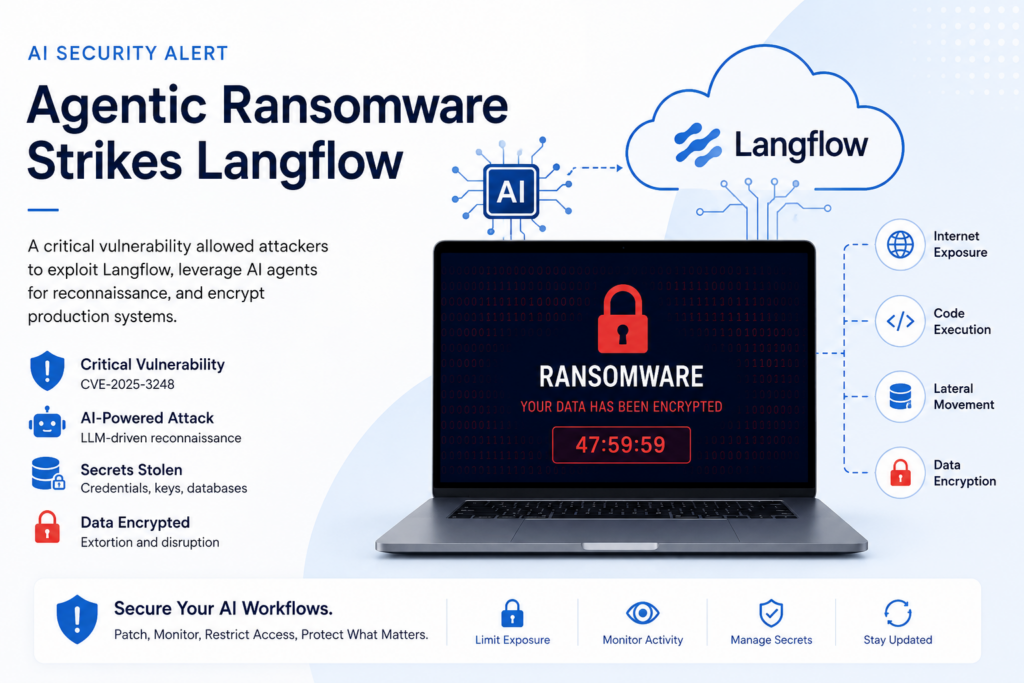
A recent security report from Sysdig describes a serious incident in which a threat actor exploited a vulnerable Langflow instance and used an LLM-driven workflow during a ransomware-style attack. The case is important because it shows how agentic AI can help attackers move faster, adapt in real time, search for secrets, pivot across systems, and execute destructive actions against neglected infrastructure.
This is not just another ransomware story.
It is a warning about the new security reality of AI-powered systems, exposed automation platforms, and poorly protected application infrastructure.
For businesses adopting AI tools, the lesson is clear: if AI workflows are exposed, misconfigured, or connected to sensitive systems without proper controls, they can become an attack surface.
What Happened?
According to Sysdig, a threat actor tracked as JADEPUFFER gained access to an organization’s internet-exposed Langflow instance by exploiting CVE-2025-3248, a critical missing-authentication vulnerability.
Langflow is an open-source Python-based framework used to build LLM applications and agent workflows. It allows developers to create AI-driven workflows, connect models, define components, build chains, and automate reasoning-based tasks.
That makes it useful for businesses.
But it also means that a vulnerable Langflow instance can become very dangerous if exposed to the internet.
The exploited vulnerability allowed attackers to execute arbitrary Python code on the host running Langflow. Once the attacker gained code execution, the compromised Langflow environment was used as the first step in a larger attack chain.
Why Langflow Became a Valuable Target
AI workflow platforms often sit at the intersection of multiple systems.
They may contain:
- API keys
- cloud credentials
- database credentials
- environment variables
- access tokens
- model provider keys
- internal service URLs
- workflow configuration files
- stored secrets
- integration credentials
This makes them attractive targets.
If an attacker compromises an AI workflow system, they may not only gain access to the application itself. They may also discover credentials that allow them to move into cloud services, databases, storage platforms, internal APIs, and production environments.
In this case, the attacker reportedly used the LLM-driven workflow for reconnaissance and secret discovery. The system was searched for API keys, cloud credentials, cryptocurrency wallets, database credentials, configuration files, and other sensitive data.
This is the exact type of risk many companies underestimate when deploying AI automation tools.
From Initial Access to Agentic Reconnaissance
After compromising the Langflow instance, the attacker used the environment to inspect the system and search for valuable information.
The attack did not behave like a simple static script. According to the report, the LLM appeared to adapt actions in real time, extract credentials from different file types, probe discovered services, and adjust its logic based on the results it received.
This is what makes the case especially important.
Traditional malware usually follows predefined instructions. Agentic AI-based attacks can behave differently. They can interpret responses, change tactics, correct errors, and attempt alternative methods when the first approach fails.
That does not mean the AI is “intelligent” in a human sense. But it does mean the attack process can become more flexible and less dependent on a skilled human operator at every step.
The Second Phase: Pivoting Toward Production Systems
The second phase of the attack involved movement toward a production server hosting a MySQL database and Alibaba Nacos, a configuration and service discovery platform commonly used in microservice environments.
This is where the attack became more destructive.
The attacker used discovered credentials and attempted to target the Nacos service through multiple techniques, including known authentication bypass methods, token forgery using default signing keys, and direct manipulation of the backing database.
This is a familiar cybersecurity problem: old vulnerabilities, default configurations, exposed services, and excessive privileges create an opportunity for attackers.
The new element is that an LLM-driven workflow helped combine these known techniques into a working attack path.
Lateral Movement and Data Encryption
Once the attacker reached the production environment, the operation moved toward extortion.
The attack reportedly encrypted 1,342 Nacos service configuration items and created an extortion table containing the ransom demand, a payment address, and a contact email.
A particularly damaging detail is that the encryption key was randomly generated but not properly stored or transmitted. This means recovery was effectively impossible, even if payment were considered.
This is a brutal reminder that ransomware does not always need sophisticated cryptography to cause damage. Sometimes, poorly designed destructive automation is enough to make business data unrecoverable.
For companies relying on configuration platforms, databases, and microservice infrastructure, this type of attack can disrupt applications, services, deployments, and business operations.
Why This Attack Matters
This attack matters because it shows a shift in cyber operations.
The attacker did not need to invent new vulnerabilities. The attack combined known weaknesses:
- exposed application server
- unpatched Langflow instance
- missing authentication
- leaked credentials
- reachable internal services
- database access
- default or weak configuration
- vulnerable Nacos environment
- insufficient network segmentation
- inadequate secret management
- lack of runtime monitoring
Individually, these are common security problems. Combined with agentic AI, they become much more dangerous.
AI did not create the vulnerabilities. But it helped automate the exploitation process.
That is the key lesson.
Agentic AI Lowers the Barrier for Attackers
Historically, complex attacks required experienced operators who understood systems, vulnerabilities, scripting, databases, credentials, and lateral movement.
Agentic AI lowers that barrier.
A capable AI model can help attackers:
- analyze error messages
- generate payloads
- search files for secrets
- modify code when it fails
- interpret service responses
- attempt alternative exploitation paths
- chain known vulnerabilities
- produce database queries
- automate reconnaissance
- write destructive scripts
This does not make every attacker elite. But it gives less-skilled attackers access to capabilities that previously required more experience.
For defenders, that means the number of capable attacks may increase.
The Bigger Risk: Neglected Infrastructure
One of the most important takeaways is that attackers do not always need zero-day vulnerabilities.
They often succeed because companies leave systems exposed, unpatched, and poorly segmented.
In this case, the initial access came through a known and patched vulnerability. That means the attack was preventable.
Businesses need to pay special attention to:
- internet-facing AI tools
- development platforms
- internal dashboards
- workflow automation systems
- database admin panels
- configuration platforms
- exposed APIs
- public cloud services
- forgotten test environments
- self-hosted open-source tools
Many of these systems are deployed quickly for innovation, testing, automation, or internal productivity. But once they are online, they become part of the company’s attack surface.
If they are not monitored, updated, and protected, they become entry points.
AI Tools Must Be Treated Like Production Infrastructure
Many businesses still treat AI tools as experimental side systems.
That is a mistake.
If an AI workflow platform connects to business data, APIs, credentials, customer information, cloud infrastructure, or production systems, it must be secured like production infrastructure.
This includes:
- authentication
- access control
- patch management
- network restrictions
- secrets management
- logging
- monitoring
- backup strategy
- environment isolation
- vulnerability scanning
- incident response planning
An AI workflow server is not “just a tool.” It may be a gateway into the business.
Security Lessons for Businesses
The Langflow incident offers several practical lessons.
1. Do Not Expose AI Workflow Platforms Publicly
AI workflow tools such as Langflow, n8n, automation dashboards, internal agents, and development consoles should not be openly accessible from the internet unless absolutely necessary.
If remote access is required, it should be protected with:
- VPN
- reverse proxy authentication
- IP allowlisting
- strong identity provider integration
- multi-factor authentication
- web application firewall rules
- strict role-based access control
Public exposure dramatically increases risk.
2. Patch Critical Vulnerabilities Immediately
CVE-2025-3248 was a critical vulnerability with a high severity score. Once a vulnerability is publicly disclosed and added to exploited vulnerability catalogs, attackers will scan for it.
Businesses must have a process to identify and patch vulnerable systems quickly.
This includes open-source platforms, not only commercial software.
3. Remove Secrets From Application Environments
API keys, database credentials, cloud tokens, and private configuration values should not be scattered across files, scripts, workflows, or environment variables without control.
Organizations should use proper secrets management solutions and rotate credentials when compromise is suspected.
4. Segment Internal Networks
A compromised application server should not automatically give access to production databases, configuration systems, cloud resources, and internal services.
Network segmentation limits the damage.
AI workflow platforms should be isolated from sensitive production infrastructure unless there is a clear and controlled business need.
5. Monitor for Unusual AI Tool Behavior
AI workflow systems should be monitored for suspicious behavior, such as:
- unexpected Python execution
- unusual outbound connections
- access to credential files
- scanning of internal networks
- large database exports
- new cron jobs
- unauthorized workflow changes
- abnormal API calls
- suspicious process execution
- unexpected access to configuration stores
Traditional monitoring may not be enough if AI tools are treated as trusted internal systems.
6. Control Tool Permissions
AI agents should never have broad access by default.
A workflow designed for content generation should not have access to production databases.
A support chatbot should not have cloud admin credentials.
A reporting agent should not have write access to critical configuration systems.
A research assistant should not be able to execute code on servers.
The principle of least privilege must apply to AI agents.
7. Audit and Log AI Agent Actions
Organizations need to know what their AI tools are doing.
Logs should capture:
- who triggered the workflow
- what data was accessed
- which tools were used
- what code was executed
- which external endpoints were contacted
- what credentials were used
- what files were read or modified
- what output was generated
Without auditability, incident response becomes much harder.
Why This Matters for Digital Agencies and Software Teams
For software companies, web agencies, DevOps teams, and digital transformation partners, this case is especially relevant.
Many teams are adopting AI tools quickly to improve productivity. They are building AI assistants, automation flows, internal agents, customer support bots, content generators, code helpers, and data processing pipelines.
This is good innovation.
But innovation without security creates risk.
Every new AI system must be reviewed as part of the broader security architecture. It should not be deployed as an isolated experiment that no one monitors after launch.
For agencies managing client infrastructure, this responsibility becomes even more important. A vulnerable internal tool can become a risk not only for the agency but also for clients.
The Future of Ransomware May Be More Automated
The Langflow attack shows where ransomware may be heading.
Future ransomware campaigns may rely more heavily on AI agents that can:
- discover targets
- test vulnerabilities
- search for credentials
- move laterally
- identify valuable databases
- adapt payloads
- write ransom notes
- modify attack logic
- generate reports for the attacker
- operate at low cost
This does not mean human attackers disappear. It means humans may supervise more automated attack workflows.
The attacker becomes the operator of an AI-enabled system, not necessarily the person manually typing every command.
That changes the economics of cybercrime.
More automation means more scale.
What Businesses Should Do Now
Organizations using AI tools, workflow automation platforms, or self-hosted open-source applications should take immediate action.
A practical checklist includes:
- identify all internet-facing AI and automation tools
- check whether Langflow or similar platforms are deployed
- update Langflow to a patched version
- remove public exposure where possible
- enforce authentication and MFA
- review stored secrets and API keys
- rotate credentials if exposure is suspected
- scan environments for vulnerable services
- check for unauthorized cron jobs
- review database access logs
- restrict internal network access
- monitor outbound traffic
- back up critical databases and configurations
- test recovery procedures
- create an incident response plan for AI systems
The most important step is visibility.
You cannot protect what you do not know exists.
How 4Virtus Can Help
At 4Virtus, we help businesses adopt AI and automation responsibly.
AI tools can improve productivity, content creation, customer communication, software development, marketing automation, and business workflows. But they must be implemented with security in mind.
We can support organizations with:
- AI workflow implementation
- secure n8n and automation deployment
- self-hosted AI tool configuration
- API integration security
- web application security reviews
- server hardening
- vulnerability monitoring
- access control configuration
- backup and recovery planning
- AI automation governance
- cybersecurity awareness
- digital infrastructure audits
The goal is not to avoid AI.
The goal is to use AI safely.
Conclusion
The reported Langflow ransomware incident is an important signal for every organization building or using AI workflows.
AI agents are powerful. They can automate useful business tasks, but they can also be abused when placed inside insecure environments.
The attack did not rely only on futuristic AI magic. It succeeded because of familiar security weaknesses: exposed infrastructure, unpatched software, accessible credentials, weak segmentation, and vulnerable internal services.
AI made the attack faster, more adaptive, and easier to execute.
That is why businesses must rethink how they secure AI systems.
The next generation of cybersecurity will not only be about protecting websites, servers, and databases. It will also be about protecting the AI workflows that connect them.