
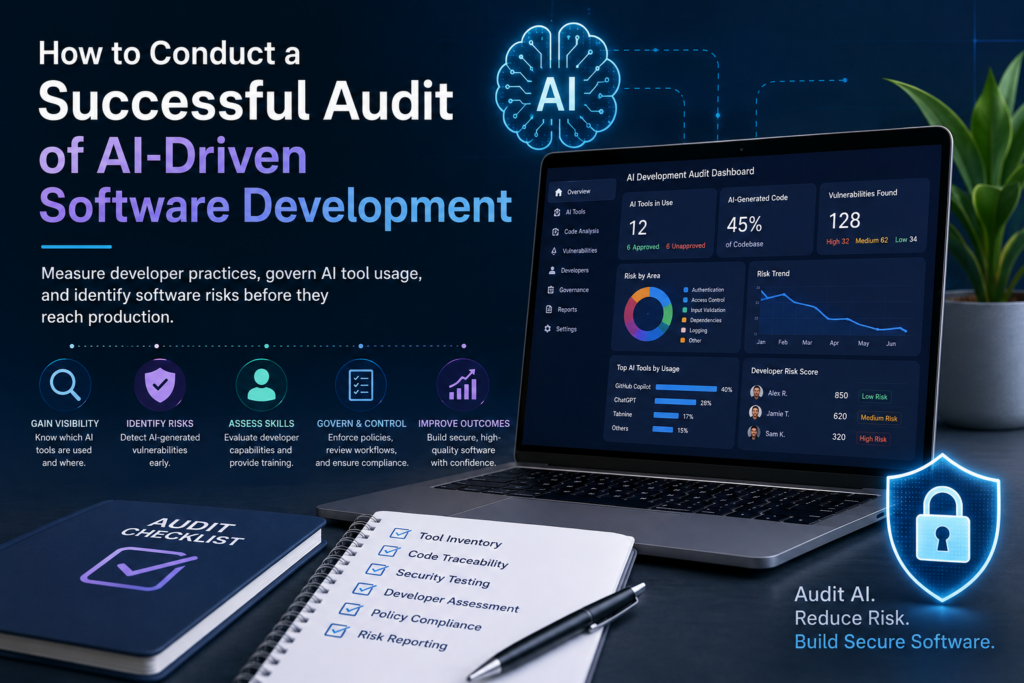
Artificial intelligence is changing the way software is built.
Developers now use AI coding assistants to generate functions, explain code, refactor applications, write tests, create documentation, debug issues, and accelerate delivery. For software teams, this is a major productivity opportunity. For businesses, it can reduce development time and improve speed to market.
But there is another side to the story.
AI-generated code can also introduce vulnerabilities, insecure patterns, hidden technical debt, dependency risks, weak logging, misconfigured permissions, and logic errors that may not be obvious during normal development.
This is why companies need a new type of software audit.
The traditional software development lifecycle is no longer enough. Organizations now need to audit the AI-driven software development lifecycle — including the tools, prompts, developers, generated code, review practices, and governance processes that shape the final product.
For CISOs, CTOs, software leaders, and business owners, the key question is no longer only:
“Are our developers writing secure code?”
The new question is:
“Are our developers, AI tools, and review processes producing secure code together?”
The Rise of AI-Driven Software Development
AI coding tools have quickly moved from experimentation to daily use.
Developers use them because they help with speed, repetitive tasks, learning, boilerplate code, bug fixing, and productivity. In many cases, AI can help teams move faster and reduce manual effort.
However, AI does not remove the need for software engineering discipline.
AI-generated code may look correct while still being insecure. It may pass a quick visual review but fail under real-world conditions. It may solve the immediate coding task but ignore secure architecture, authentication rules, access control, logging, error handling, input validation, or compliance requirements.
This creates a new category of software risk.
The risk does not come only from external attackers. It can originate inside the development process itself, when insecure AI-generated code enters the codebase without proper validation.
From SDLC to ADLC: The Agentic Development Lifecycle
For years, companies have managed software risk through the SDLC — the Software Development Lifecycle.
The SDLC includes planning, design, development, testing, deployment, maintenance, and review.
But AI changes this process.
When developers use AI assistants, autonomous coding agents, LLM-based refactoring tools, or AI-connected development environments, the lifecycle becomes more complex. The code is no longer created only by humans. It is shaped by models, prompts, context windows, plugins, integrations, code repositories, documentation, and automated suggestions.
This creates what can be called the ADLC — the Agentic Development Lifecycle.
The ADLC includes:
- human developers
- AI coding assistants
- autonomous agents
- prompts and instructions
- model outputs
- code review tools
- security scanners
- MCP integrations
- repositories
- CI/CD pipelines
- approval workflows
- production deployment controls
Auditing modern software development means auditing this full ecosystem.
Why AI-Generated Code Needs a Different Audit Approach
Traditional audits usually examine records, policies, controls, and compliance evidence. In software development, this may include code reviews, deployment logs, access permissions, security testing, change approvals, and documentation.
AI-driven development requires additional visibility.
An effective audit must answer questions such as:
- Which AI tools are developers using?
- Are those tools approved by the organization?
- Are developers using personal AI accounts for company code?
- Is sensitive source code being pasted into external AI systems?
- Which parts of the codebase were AI-generated?
- Was AI-generated code reviewed by a human?
- Were security tests applied before deployment?
- Which AI tools produce the most insecure output?
- Which teams rely too heavily on AI suggestions?
- Are developers trained to identify AI-generated vulnerabilities?
- Are AI agents connected to internal repositories, tools, or data sources?
- Can the organization trace AI influence inside production code?
Without these answers, leadership cannot accurately measure risk.
The Main Risk: Speed Without Control
AI can help developers produce more code faster. But faster code creation does not automatically mean faster secure delivery.
In many organizations, AI increases the volume of code while the review, testing, and governance processes remain unchanged. This creates a bottleneck and a security gap.
The danger is not that AI writes code.
The danger is that AI-written code enters production without the same level of validation as human-written code.
AI may introduce:
- insecure authentication logic
- weak access control
- SQL injection risks
- cross-site scripting vulnerabilities
- poor error handling
- exposed secrets
- insecure API calls
- missing rate limits
- insufficient logging
- unsafe dependencies
- incorrect encryption usage
- misconfigured permissions
- denial-of-service weaknesses
- outdated coding patterns
These issues may not be intentional, but they can still create serious business risk.
The Role of the CISO in AI-Driven Development
CISOs are now responsible for understanding how AI affects software security.
This does not mean blocking AI tools. Blocking AI completely is usually unrealistic and counterproductive. Developers will still find ways to use them if they create value.
The better approach is governance.
CISOs should work with CTOs, development leaders, DevOps teams, compliance teams, and business stakeholders to build a controlled AI development environment.
The goal is to allow innovation while reducing unmanaged risk.
A strong AI development audit helps CISOs answer board-level questions such as:
- Where is AI increasing software risk?
- Which teams are using AI most heavily?
- Which tools are approved and which are not?
- Which vulnerabilities are linked to AI-generated code?
- Are developers skilled enough to validate AI output?
- Are policies being followed?
- Are we improving productivity without increasing production risk?
- Can we prove compliance and traceability?
These are no longer technical questions only. They are business risk questions.
Step 1: Establish Visibility Into AI Tool Usage
The first step in auditing AI-driven development is visibility.
Organizations need a verifiable record of which AI tools are being used across development teams.
This includes sanctioned tools, such as approved enterprise coding assistants, and unsanctioned tools, such as personal AI accounts or browser-based chatbots.
The audit should document:
- tool name
- user or team
- purpose of use
- frequency of use
- data accessed
- code generated
- repository affected
- security controls applied
- approval status
- integration points
This helps identify shadow AI usage.
Shadow AI happens when employees use AI tools without official approval, oversight, or security review. In software development, this can expose company code, secrets, architecture details, customer data, or proprietary logic.
Visibility is the foundation of governance.
Step 2: Map AI Usage to Code Output
Knowing that developers use AI tools is not enough.
The audit should also connect AI usage to actual code outputs.
Organizations should try to understand where AI-generated code appears in:
- commits
- pull requests
- branches
- production releases
- test cases
- documentation
- scripts
- configuration files
- infrastructure-as-code templates
- API integrations
- database migrations
This mapping creates traceability.
If a vulnerability is later discovered, the team should be able to determine whether the vulnerable code was written manually, generated by AI, modified from AI output, or introduced through an AI-assisted workflow.
Traceability is essential for accountability, compliance, and continuous improvement.
Step 3: Evaluate the Security Performance of AI Tools
Not all AI coding tools perform equally.
Different models, platforms, prompts, and integrations produce different levels of code quality and security. Some may be strong at syntax and refactoring but weak at secure architecture. Others may generate clean-looking code but fail to apply modern security controls.
An audit should benchmark AI tools against known vulnerability patterns.
This can include testing tools against scenarios such as:
- authentication and authorization
- input validation
- API security
- session management
- database queries
- file uploads
- encryption
- logging
- error handling
- dependency management
- secure configuration
- cloud permissions
- secrets handling
The goal is not to find a perfect AI tool. The goal is to understand the risk profile of each tool and decide which tools are approved for which use cases.
For example, one tool may be acceptable for documentation, test generation, and boilerplate code, but not for security-sensitive backend logic.
Step 4: Review Developer Capabilities
AI tools do not affect every developer in the same way.
A senior developer with strong secure coding knowledge may use AI effectively and catch mistakes before they enter the codebase. A less experienced developer may accept AI suggestions without fully understanding their implications.
This is why the audit should include developer capability assessment.
Organizations should evaluate:
- secure coding knowledge
- ability to identify AI-generated vulnerabilities
- understanding of authentication and authorization
- awareness of common vulnerability classes
- review discipline
- dependency risk awareness
- ability to challenge AI output
- understanding of company security standards
- use of approved tools and workflows
This should not be treated as punishment.
It should be used to identify training needs, improve team maturity, and reduce unintentional risk.
Step 5: Create a Developer Risk and Support Score
One useful approach is to create an internal risk score for AI-driven development practices.
This can work like a cybersecurity maturity indicator, not as a personal ranking system.
The score can consider:
- AI tool usage frequency
- type of code generated
- security sensitivity of projects
- number of AI-linked issues found
- quality of code reviews
- secure coding assessment results
- history of production defects
- adherence to approved workflows
- use of testing and scanning tools
- training completion
- peer review quality
The purpose is to identify where additional support is needed.
A team building payment systems, authentication modules, or customer data platforms should have stricter controls than a team using AI to generate internal documentation.
Risk scoring helps apply governance where it matters most.
Step 6: Audit Prompts, Context and Data Exposure
AI-driven development is not only about generated code. It is also about what information is shared with AI systems.
Developers may paste source code, error logs, API responses, database schemas, infrastructure details, environment variables, or customer data into AI tools.
This can create confidentiality and compliance risks.
The audit should examine:
- whether sensitive data is shared with AI tools
- whether prompts contain proprietary code
- whether logs include secrets or customer information
- whether AI tools store or train on submitted data
- whether enterprise privacy settings are enabled
- whether developers understand data-sharing rules
- whether prompts are logged for compliance
- whether external tools are approved for confidential content
Clear policy is essential.
Developers need to know what they can and cannot share with AI systems.
Step 7: Control MCP and Agent Integrations
Modern AI development tools are moving beyond simple chat prompts. They can connect to repositories, ticketing systems, databases, internal documentation, cloud tools, terminals, browsers, and deployment environments.
Model Context Protocol integrations and agentic development tools create new power and new risk.
An AI agent connected to the wrong tools can access sensitive data, modify files, execute commands, or interact with systems beyond its intended scope.
The audit should review:
- which MCP servers are used
- which tools are connected
- what permissions agents have
- whether agents can execute commands
- whether agents can access production data
- whether agents can write to repositories
- whether tool access is logged
- whether permissions follow least privilege
- whether approvals are required for sensitive actions
AI agents should not receive broad permissions by default.
They should be treated like privileged automation accounts.
Step 8: Strengthen Code Review for AI-Generated Code
AI-generated code should not bypass review.
In fact, it may require more careful review because it can look convincing while containing hidden problems.
A strong review process should include:
- human review
- automated static analysis
- dependency scanning
- secrets scanning
- unit tests
- security tests
- policy checks
- architecture review for sensitive components
- approval gates before production
- documentation of AI involvement
Code reviewers should be trained to ask specific questions:
- Does this code validate input correctly?
- Are permissions properly checked?
- Are errors handled safely?
- Are logs useful without exposing secrets?
- Are dependencies safe and current?
- Is the code maintainable?
- Does it match company standards?
- Did AI invent functions, assumptions, or unsafe shortcuts?
- Is the code overcomplicated or unnecessary?
AI can generate code quickly, but responsibility remains human.
Step 9: Use Time-Based and Commit-Based Auditing
When a vulnerability is discovered, teams need to find all related code quickly.
This is where commit-based auditing becomes valuable.
If an organization can trace AI-generated code to specific commits, branches, tools, and developers, it can isolate risk faster.
For example:
- a specific AI model is found to generate insecure authentication patterns
- a coding assistant is compromised or misconfigured
- a developer used an unapproved tool
- a vulnerable code pattern appears across multiple repositories
- a prompt template produced unsafe output
- a dependency recommendation introduced risk
With proper traceability, teams can identify affected commits and fix them faster.
Without traceability, they may need long manual reviews across large codebases.
Step 10: Connect AI Audits to Business Outcomes
A good audit should not only produce technical findings.
It should help leadership make better decisions.
The audit should connect AI usage to:
- productivity
- code quality
- vulnerability rates
- review time
- developer training needs
- production incidents
- compliance readiness
- customer risk
- tool investment
- delivery speed
- maintenance cost
This allows leaders to see whether AI is creating real value or only increasing output volume.
The business goal is not simply to use more AI.
The goal is to use AI in a way that improves delivery while protecting quality, security, and trust.
Building an AI Development Governance Framework
An effective audit should lead to a governance framework.
This framework may include:
- approved AI tools list
- prohibited tools list
- data-sharing rules
- secure prompt guidelines
- review requirements
- AI-generated code labeling
- repository policies
- CI/CD security gates
- developer training
- tool benchmarking
- periodic audits
- risk scoring
- incident response procedures
- model and plugin approval process
- agent permission rules
- compliance reporting
Governance should not slow developers unnecessarily.
It should give them a safe path to use AI productively.
Common Mistakes to Avoid
Organizations often make several mistakes when adopting AI for software development.
Mistake 1: Assuming AI Output Is Secure
AI-generated code must be validated. It should never be trusted automatically.
Mistake 2: Ignoring Shadow AI
If companies do not provide approved tools, developers may use unapproved ones.
Mistake 3: Applying the Same Rules to Every Use Case
Generating documentation is not the same as generating authentication logic. Governance should be risk-based.
Mistake 4: Skipping Developer Training
AI does not replace secure coding knowledge. It makes secure coding knowledge even more important.
Mistake 5: Treating AI Governance as an IT Policy Only
AI-driven development affects legal, compliance, security, product quality, customer trust, and business continuity.
How 4Virtus Can Help
At 4Virtus, we help businesses adopt AI and automation in a practical, secure, and business-focused way.
AI can improve software development, marketing automation, customer support, content creation, reporting, and internal workflows. But successful AI adoption requires more than tool installation. It requires process, governance, security, and measurable outcomes.
We can support organizations with:
- AI workflow consulting
- AI tool governance
- secure software development practices
- AI-assisted development policies
- code review and audit support
- web application security review
- automation architecture
- n8n and AI agent workflow design
- self-hosted AI infrastructure planning
- cybersecurity awareness
- developer process optimization
- secure API and integration design
The goal is to help companies benefit from AI without creating unmanaged risk.
Conclusion
AI-driven software development is becoming normal. The question is not whether developers will use AI, but whether organizations will manage that use responsibly.
AI can improve productivity, accelerate delivery, and support innovation. But without proper auditing, it can also introduce vulnerabilities, expose sensitive data, weaken accountability, and create hidden security debt.
A successful audit of AI-driven software development gives organizations visibility into tools, users, code, risks, skills, and business impact.
It helps CISOs and development leaders answer the most important question:
Are we building faster — or are we building safer and faster?
In the AI era, speed alone is not enough.
Secure innovation requires visibility, governance, developer skill, tool control, and continuous auditing.