
Cybersecurity teams are under constant pressure. Every day, new vulnerabilities are published, exploits are discussed across security communities, threat actors move faster, and organizations must decide which risks require immediate action.
The challenge is no longer only access to information. The real challenge is filtering the noise.
Security teams receive alerts from government databases, vulnerability feeds, cybersecurity news websites, vendor advisories, community intelligence platforms, internal logs, and monitoring tools. Without automation, this creates alert fatigue, delayed response, duplicated work, and missed critical vulnerabilities.
This is where AI-powered threat intelligence automation becomes valuable.
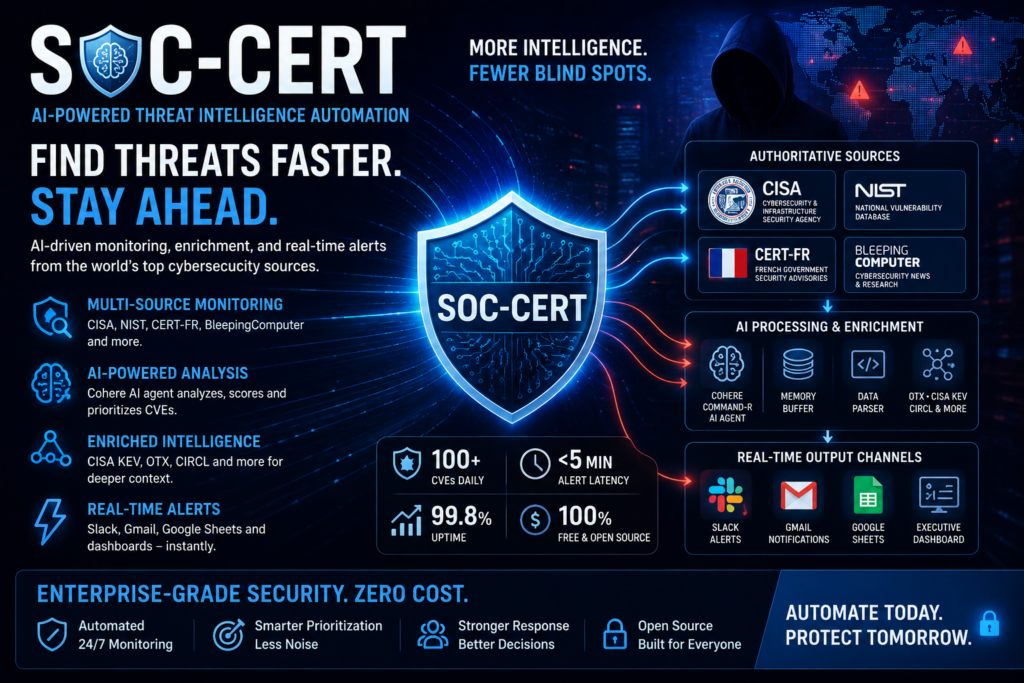
SOC-CERT is an automated cybersecurity monitoring workflow designed to collect vulnerability intelligence from multiple trusted sources, analyze CVE data with artificial intelligence, enrich it with additional context, and deliver structured real-time alerts through Slack, Gmail, Google Sheets, and dashboards.
Built with n8n, Bright Data, AI agents, enrichment APIs, and multi-channel notifications, SOC-CERT shows how security operations can become faster, smarter, and more proactive.
What Is SOC-CERT?
SOC-CERT is an AI-powered automated threat intelligence system that continuously monitors cybersecurity vulnerabilities and threat alerts from multiple authoritative sources.
Its purpose is simple: help security teams identify important vulnerabilities faster and reduce the manual effort required to track, analyze, prioritize, and communicate cyber risks.
The workflow monitors sources such as:
- CISA
- NIST NVD
- CERT-FR
- BleepingComputer
- AlienVault OTX
- additional enrichment APIs
It then uses AI to analyze the collected information, extract structured CVE details, assess severity, enrich the findings, remove duplicates, and notify the right people through the right channels.
In practice, SOC-CERT functions like an automated threat intelligence analyst.
It collects information, understands the context, prioritizes risk, and delivers actionable alerts.
Why Threat Intelligence Automation Matters
Modern vulnerability management is a race against time.
When a critical vulnerability appears, attackers may begin scanning the internet almost immediately. Security teams must quickly answer several important questions:
- Is this vulnerability relevant to our organization?
- Is it actively exploited?
- How severe is the risk?
- Which systems may be affected?
- Is there a known exploit?
- Is there a patch or mitigation?
- Who needs to be notified?
- Should this become an investigation ticket?
- Has the team already seen this CVE from another source?
Answering these questions manually takes time. And when hundreds of CVEs appear every day, manual monitoring becomes inefficient.
SOC-CERT helps solve this by automating the first layer of threat intelligence processing.
Instead of forcing security teams to search multiple websites and feeds, the workflow brings information together, processes it, and delivers a clean summary.
This improves speed, consistency, and visibility.
The Main Business Problem: Alert Fatigue
Security teams do not suffer from a lack of alerts. They suffer from too many alerts.
Many organizations receive notifications from multiple tools, but not every alert is equally important. Some are duplicates. Some are low priority. Some lack context. Some are not relevant to the organization. Some arrive too late.
This creates alert fatigue.
When teams are overwhelmed, they may miss the alerts that truly matter.
SOC-CERT addresses this by combining automation, AI analysis, data enrichment, and structured notification logic. The system is designed to reduce unnecessary noise and highlight vulnerabilities that require attention.
The goal is not to send more alerts.
The goal is to send better alerts.
How SOC-CERT Works
The SOC-CERT workflow operates as a complete threat intelligence automation pipeline.
It can be divided into four main layers:
- Data collection
- AI processing and analysis
- Enrichment and deduplication
- Notification and reporting
Each layer plays an important role in transforming raw cybersecurity information into actionable intelligence.
1. Data Collection Layer
The first step is collecting information from trusted cybersecurity sources.
SOC-CERT uses Bright Data’s scraping infrastructure as the core data collection layer. This allows the workflow to reliably collect data from public cybersecurity sources that may include dynamic content, rate limits, anti-bot protection, or changing page structures.
The workflow can monitor sources such as:
- CISA security advisories and KEV catalog
- NIST NVD CVE database
- CERT-FR government advisories
- BleepingComputer cybersecurity news
- community intelligence sources
- enrichment APIs
This multi-source approach is important because no single source gives the full picture.
Government databases provide authority.
Community platforms provide early signals.
Cybersecurity news provides context.
Enrichment APIs provide additional intelligence.
AI analysis connects the information into a usable summary.
By combining different sources, SOC-CERT provides broader visibility and reduces the chance of missing important developments.
2. AI Processing Core
After the data is collected, the workflow sends it into an AI processing layer.
The AI agent is configured to analyze and extract CVE details from multi-source cybersecurity alerts. It outputs structured data with field mapping, severity interpretation, enrichment details, and prioritization logic.
The AI model used in the described implementation is Cohere Command-R, selected for technical data extraction and structured output generation.
The AI processing layer can extract information such as:
- CVE ID
- vulnerability name
- affected technology
- severity
- source
- exploitation status
- summary
- recommended action
- enrichment data
- confidence level
- alert priority
This is valuable because raw threat intelligence is often inconsistent. Different sources may describe the same vulnerability in different formats. Some may include severity, while others may focus on exploit activity, vendor response, or patch availability.
AI helps normalize this information into a consistent structure.
3. Enrichment, Deduplication and Risk Scoring
One of the most important parts of the SOC-CERT architecture is enrichment.
The workflow does not only collect vulnerability data. It also enriches it with additional threat intelligence from sources such as CISA KEV, CIRCL, and AlienVault OTX.
This helps answer a critical question:
Is this vulnerability just published, or is it actively dangerous?
For example, a CVE may be technically severe but not yet exploited. Another CVE may have a lower theoretical score but be actively used by attackers. Enrichment helps security teams understand the real-world risk.
SOC-CERT also includes duplicate detection.
Multiple sources may report the same CVE. Without deduplication, teams may receive repeated alerts for the same vulnerability. This increases noise and reduces trust in the alerting system.
The workflow solves this with hash-based change detection, ensuring that repeated CVE mentions do not flood the team unless there is meaningful new information.
This creates a cleaner alert pipeline.
4. Multi-Channel Notifications
Once the vulnerability is analyzed, enriched, and prioritized, SOC-CERT delivers alerts through multiple communication channels.
The workflow supports:
- Slack notifications
- Gmail alerts
- Google Sheets logging
- executive dashboards
- health monitoring dashboards
- admin alerts
This is important because different stakeholders need different types of information.
A security analyst may need a detailed Slack alert.
A manager may need a summarized email.
A leadership team may need a dashboard.
A compliance team may need structured logs.
A technical team may need a ticket or investigation trigger.
SOC-CERT makes the same intelligence available in multiple formats.
Interactive Slack Alerts
One of the most useful features is interactive Slack alert management.
The system can display alerts in Slack with action buttons such as:
- Ack
- Investigate
- Dismiss
These actions support a practical alert lifecycle.
Ack allows a team member to confirm that the alert has been seen.
Investigate can create an investigation ticket or trigger a follow-up workflow.
Dismiss can archive false positives with reason logging.
This creates accountability and improves team collaboration.
In the described implementation, the Slack buttons are prepared and displayed correctly for demonstration, while production use requires webhook integration to trigger real actions.
This is a strong foundation for future SOAR-style alert management.
Technical Implementation
The SOC-CERT workflow is built using n8n as the automation engine.
n8n orchestrates the complete process:
- scheduled execution
- API requests
- web scraping
- AI model calls
- data parsing
- enrichment lookups
- deduplication
- notification delivery
- dashboard updates
- retry logic
- error handling
The technical stack includes:
- n8n workflow automation
- Bright Data scraping infrastructure
- Cohere Command-R AI agent
- memory buffer for contextual correlation
- output parser for structured results
- CISA KEV integration
- AlienVault OTX enrichment
- CIRCL enrichment
- Google Sheets logging
- Slack notifications
- Gmail alerts
- dashboard monitoring
This architecture shows how low-code automation and AI can be combined to create enterprise-grade security workflows without building a complete custom platform from scratch.
Why Bright Data Is Used
Reliable data collection is one of the most difficult parts of threat intelligence automation.
Public websites may use anti-bot protection, dynamic rendering, geographic restrictions, rate limits, or changing HTML structures. If scraping fails, the entire workflow becomes unreliable.
Bright Data helps solve this by supporting reliable web data extraction across the monitored sources.
In this architecture, Bright Data is used for:
- CISA data collection
- NIST vulnerability data extraction
- CERT-FR advisories
- BleepingComputer monitoring
- dynamic page rendering
- reliable 24/7 collection
- reduced IP blocking
- improved scraping stability
For a threat intelligence system, reliability is not optional. If the collection layer fails, the security team may miss important alerts.
Error Handling and Resilience
Most automation systems fail when external services are unavailable.
Cybersecurity feeds, APIs, websites, and enrichment platforms may temporarily go offline or return inconsistent responses. A production-ready workflow must handle this gracefully.
SOC-CERT includes:
- retry mechanisms
- continue-on-error logic
- error tracking
- health monitoring
- fallback notifications
- duplicate detection
- rate limiting
- graceful degradation
This means the system can continue operating even if one source fails temporarily.
Instead of breaking the entire workflow, the system logs the issue, retries when possible, and continues processing other sources.
This resilience architecture is essential for security operations.
AI Consistency and Structured Output
One of the key lessons from the SOC-CERT implementation is that AI agents require strict output constraints.
If an AI model is allowed to freely interpret vulnerability severity or change formats between executions, the workflow becomes unreliable.
To solve this, SOC-CERT uses structured output parsing and data normalization layers.
This ensures that the AI-generated results remain consistent and usable by downstream systems such as Google Sheets, Slack, dashboards, and investigation workflows.
In cybersecurity automation, AI should not only sound intelligent. It must produce reliable, structured, machine-readable data.
Performance and Scalability
SOC-CERT is designed to process more than 100 CVEs per day with low latency and high availability.
The described implementation includes:
- monitoring of four primary threat intelligence sources
- three enrichment APIs
- multi-channel alert delivery
- under five-minute alert latency
- high uptime through resilient scraping and retry logic
- duplicate prevention
- structured logging
- dashboard visibility
The system is also designed for future expansion to more than 1,000 CVEs per day by adding additional sources, parallel processing, and improved enrichment logic.
This makes SOC-CERT useful not only for small teams but also for larger security operations.
Business Value for Organizations
SOC-CERT creates value in several ways.
Faster Vulnerability Awareness
Security teams receive alerts faster because the workflow continuously monitors multiple sources and automatically delivers notifications.
Reduced Manual Work
The system reduces the need for manual checking of vulnerability databases, advisories, and news sources.
Better Prioritization
AI scoring and enrichment help teams understand which vulnerabilities require immediate attention.
Less Alert Fatigue
Duplicate detection and smart filtering reduce repeated and low-value alerts.
Improved Collaboration
Slack notifications, email alerts, Sheets logging, and dashboards make it easier for teams to coordinate.
Stronger Executive Visibility
Leadership teams can see vulnerability trends, alert volume, source health, and system performance through dashboards.
Lower Cost
The workflow is designed around free-tier services and open-source components, making enterprise-grade monitoring more accessible.
Why This Matters for Small and Medium-Sized Businesses
Many smaller organizations do not have a full security operations center.
They may rely on external IT support, hosting providers, manual updates, or occasional vulnerability checks. This creates risk, especially as cyber threats become more automated and faster-moving.
SOC-CERT-style automation can give smaller businesses access to capabilities that were previously available mainly to large enterprises.
With the right setup, even a lean team can monitor critical threat intelligence sources, receive structured alerts, and respond faster to emerging vulnerabilities.
This is especially important for companies running:
- WordPress websites
- e-commerce platforms
- custom web applications
- cloud services
- CRM systems
- ERP systems
- customer portals
- payment integrations
- public APIs
- internal business applications
The more digital systems a business uses, the more important vulnerability awareness becomes.
Future Enhancements
The SOC-CERT architecture is designed for expansion.
Future improvements may include:
- SIEM integration with Splunk or Elasticsearch
- SOAR platform connectivity
- mobile notifications
- SMS alerts for critical vulnerabilities
- multi-language processing
- historical trend analysis
- industry-specific scoring models
- custom alert thresholds
- expanded international CERT integrations
- machine learning for threat pattern recognition
- PWA dashboard for mobile access
- automatic investigation ticket creation
- asset-based vulnerability matching
One of the most valuable future features would be matching CVEs against the organization’s own asset inventory. This would allow the system to answer not only “Is this CVE critical?” but also “Does this CVE affect us?”
That is where threat intelligence becomes truly actionable.
How 4Virtus Can Help
At 4Virtus, we help businesses design and implement practical AI automation workflows that solve real operational problems.
SOC-CERT is a strong example of how AI, automation, cybersecurity intelligence, and workflow orchestration can work together.
We can help organizations build customized solutions for:
- AI-powered threat intelligence monitoring
- n8n workflow automation
- cybersecurity alert systems
- CVE monitoring workflows
- Slack and email notification systems
- Google Sheets and dashboard reporting
- AI data extraction and scoring
- API integrations
- web scraping automation
- business process automation
- AI agents for operational workflows
- self-hosted automation infrastructure
Every organization has different systems, risks, and response processes. That is why automation should be adapted to the business, not copied blindly.
A properly designed SOC-CERT-style workflow can become a valuable part of a company’s cybersecurity and digital operations strategy.
Conclusion
Cybersecurity teams need speed, accuracy, and focus.
The number of vulnerabilities is growing. Attackers are moving faster. Security teams are overloaded with information. Manual monitoring is no longer enough.
SOC-CERT demonstrates how AI-powered threat intelligence automation can help organizations monitor trusted sources, analyze CVEs, enrich alerts, reduce duplicates, and notify teams in real time.
By combining n8n, Bright Data, AI agents, government threat intelligence, community data, and multi-channel notifications, businesses can create a more proactive and scalable cybersecurity monitoring process.
The future of cybersecurity operations will not depend only on more tools. It will depend on smarter workflows.
AI-powered automation gives security teams the ability to detect faster, prioritize better, and respond with greater confidence.